


I-551 form – Who Issues It, When You Receive It, and What It Proves
You have almost certainly heard of a “Green Card”; it’s one of the most recognized immigration documents in the world. But if you’ve seen official government paperwork or looked closely at the card itself, you may have encountered a different, more confusing name: Form I-551. The answer is simple: they are the exact same thing.
Form I-551 is the official government code for the physical Permanent Resident Card you receive after being approved to live and work in the United States. Despite the word “Form” in its name, this is not a document you fill out. Instead, it is the powerful identification card you are given as definitive proof of your Lawful Permanent Resident (LPR) status.
Your Form I-551 is your all-in-one key to building a life in the U.S. It is the single document that proves your identity and your authorization to work for any employer. According to U.S. Citizenship and Immigration Services (USCIS)
Immigration Lawyer in Phoenix
At Ybarra Maldonado Law Group , we regularly help immigrants and families understand their legal status and protect their permanent residency. Below, we break down the Form I 551 form in simple, practical terms.
What Does Your Form I-551 Actually Prove?
While you might know it as a Green Card, your Form I-551 is much more than a simple ID. It is official, physical proof that you have been granted Lawful Permanent Resident (LPR) status. This legal status is the key that unlocks your new life, and the card in your wallet is how you prove you have it.
Holding LPR status means you have the right to live and work in the U.S. on a permanent basis. It is the status, not just the plastic card itself, that grants these fundamental rights. Think of it this way: your driver’s license proves you have the right to drive, but it isn’t the source of that right—your legal permission is. The same is true for your Green Card; it’s the most important piece of evidence you have.
This distinction becomes clear when you start a new job. To comply with federal law, your employer will ask for proof you are authorized to work in the U.S. By presenting your Form I-551, you are providing definitive proof of permanent residency for employment.
Permanent Resident Card or Form I-551 – Explained
Form I-551 is the official name for the Permanent Resident Card, commonly known as the Green Card. It serves as proof that a person is a lawful permanent resident (LPR) of the United States.
The term “Form I-551” refers to the document itself — not an application you fill out.
Decoding the Information of Your Green Card
Each piece of information printed on your Form I-551 tells an important part of your story and is key to using your card correctly. Several fields are especially important to recognize, as they will help you fill out forms, answer official questions, and manage your status for years to come.
- Alien Number (A#): This is your unique, lifelong identification number with U.S. Citizenship and Immigration Services (USCIS). Think of it like a Social Security Number, but for immigration. You will use this A-Number on nearly every immigration form you ever file.
- Category: This short code (like “IR1” or “E26”) explains the immigration path you took to become a permanent resident, such as through a family member or employment.
- Card Expires: This is the date your physical card is no longer valid as an ID or travel document.
That “Card Expires” date causes the most confusion. Your permanent resident status itself does not end. The date on the card is simply a deadline for renewing the document itself, much like renewing a driver’s license. An expired green card doesn’t mean you’ve lost your residency, but it can create major problems for work and travel. Keeping this card valid is essential. Some cards expire in two years while others last for ten, a difference that depends on the category printed on your card.
Who Issues Form I-551?
Form I-551 is issued by U.S. Citizenship and Immigration Services (USCIS), which operates under the U.S. Department of Homeland Security.
USCIS produces and mails the physical permanent resident card after:
- Approval of adjustment of status
- Approval of an immigrant visa through consular processing
- Removal of conditions (in conditional cases)
- Replacement card requests
2-Year vs. 10-Year Cards: Why the Expiration Dates Differ
The “Card Expires” date is a crucial detail, and the difference between a two-year and ten-year validity period is significant. This distinction is most often related to how you received your green card. If you became a permanent resident through a marriage that was less than two years old at the time of approval, you will likely receive a two-year card. This is called conditional permanent resident status.
This is not a temporary card, but a green card with a built-in checkpoint to confirm your marriage is authentic and ongoing. Most other residents receive a standard ten-year card.
For those with a two-year conditional card, the path forward is different from a simple renewal. You cannot just apply for a new card. Instead, you must file Form I-751, Petition to Remove Conditions on Residence, during the 90-day window before your card expires. By filing this form with your spouse and providing evidence of your shared life, you are proving to the U.S. government that your marriage remains genuine. This is a critical step to secure your long-term status.
Once your Form I-751 petition is approved, you will receive the standard ten-year, renewable green card. From that point on, you will follow the same renewal process as all other permanent residents. Since these petitions can take time to process, USCIS provides ways to get temporary proof of your status to avoid any disruption to your life.
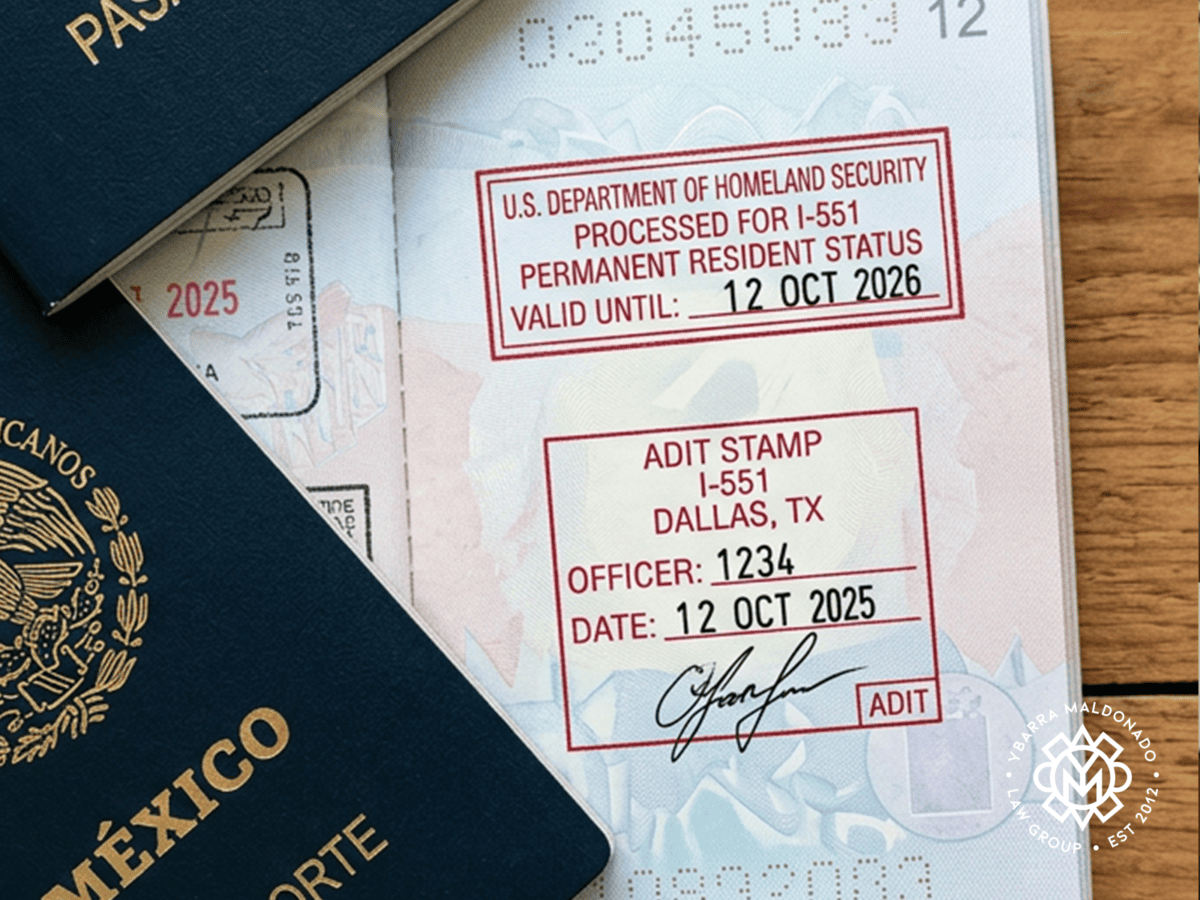
Through a Temporary I-551 Stamp
In some cases, USCIS places an I-551 stamp in your passport.
This stamp serves as temporary proof of permanent residence until your physical card arrives.
Lost or Expired Card? How to Get Temporary Proof with an ADIT Stamp
A common worry for permanent residents is what to do if their green card is lost, stolen, or expires while they are waiting for a new one. Without that physical card, it’s difficult to prove your status to an employer or re-enter the country. Fortunately, U.S. Citizenship and Immigration Services (USCIS) provides a reliable, temporary solution.
This temporary proof is a special stamp placed directly in your valid, unexpired passport. It is officially called an ADIT stamp (Alien Documentation, Identification, and Telecommunication), but you will often hear it called a temporary I-551 stamp. For all practical purposes, this stamp acts as your green card. You can present it to employers for Form I-9 employment verification and use it for international travel, just as you would your physical card.
Getting this stamp isn’t automatic; you must request it. Typically, USCIS ADIT stamp eligibility requires you to have a pending application to renew or replace your green card (Form I-90).
What Does Form I-551 NOT Prove?
It does not prove:
- U.S. citizenship
- Immunity from deportation
- That status cannot be revoked
- That you can remain outside the U.S. indefinitely
Permanent residency can still be placed at risk under certain circumstances.
At Ybarra Maldonado Law Group, we often assist permanent residents facing issues related to criminal charges, travel complications, or abandonment concerns.
How to Renew or Replace Your Form I-551 with Form I-90
Whether your 10-year green card is nearing its expiration date or has been lost, stolen, or damaged, the solution is the same: you must file Form I-90, Application to Replace Permanent Resident Card. This form is specifically for renewing or replacing a 10-year card. If you have a 2-year conditional card, you must use the separate process to remove the conditions on your residence, not Form I-90.
For renewals, timing is key. You should file your Form I-90 within the six months leading up to your card’s expiration date. Filing too early can lead to your application being rejected, while waiting too long can leave you with an expired card. Since the renewal process can take many months, starting on time is essential.
One of the most helpful parts of this process is the automatic extension you receive after filing. Once USCIS accepts your Form I-90, they will mail you a receipt notice. This notice, when presented with your expired green card, automatically extends your card’s validity for a significant period (often 48 months), giving you valid proof of status while you wait for your new card to arrive.
Filing Form I-90 is also the correct step if your card is ever lost or stolen. Be prepared for the green card renewal fee, as there is a government cost for processing the application.
Your Next Steps: Protecting and Using Your Permanent Resident Status
Your Form I-551 is the single most important document proving your right to live and work in the United States. This knowledge empowers you to protect your status for the years to come. To safeguard your status and ensure peace of mind, follow this simple checklist:
Your 3-Point Checklist:
- Photocopy Your Card: Keep a digital and physical copy in a safe place.
- Set a Renewal Reminder: Put a calendar alert 8 months before your card’s expiration date to start the green card renewal process.
- Update Your Address: Always file Form AR-11 with USCIS within 10 days of moving.
Your Form I-551 is more than just a card—it’s your key to building a life in the United States. By taking these small steps, you are securing the freedom and stability to focus on your future. You are no longer just holding a document; you are holding proof of your new beginning.
Conditional vs. Permanent Form I-551
There are two types:
Conditional Permanent Resident Card
- Valid for 2 years
- Issued through marriage or certain investments
- Requires removal of conditions
Regular Permanent Resident Card
- Valid for 10 years
- Standard long-term permanent residency
Failure to remove conditions can lead to serious immigration consequences.
Get a free consultation.
At Ybarra Maldonado Law Group, we assist permanent residents in:
- Protecting residency after criminal charges
- Avoiding abandonment issues
- Replacing lost cards
- Preparing for naturalization
- Responding to immigration enforcement concerns
Your permanent resident status is valuable and it must be protected properly.